Home
Neck Ageing & Skin Laxity
Areas of Concern · Lower Face

Sagging Jawline & Jowls

Loss of jawline definition is one of the most common features of facial ageing. A youthful jawline is defined not only by sharpness, but by clear separation between the face and neck. As deeper tissues descend over time, that distinction gradually becomes less defined.

Early jowling often develops beside the chin first, while heaviness through the lower face can soften the mandibular border even before significant skin laxity appears. This reflects structural alterations within deeper tissues rather than surface ageing alone.
Assessment & Treatment
Assessment at Dr. Sim Lew-Gor’s practice focuses on identifying the underlying anatomical causes of jawline change rather than addressing the visible contour in isolation. Treatment is planned accordingly.
  • Facelift
  • Facelift with Neck Lift
  • Non-Surgical Contouring
  • Combined Approaches
Consultations available in Melbourne & Wagga Wagga. Consultation fee is non-redeemable.
Why Jawline Definition Is Lost

Four Contributing Anatomical Factors

Jawline definition depends on the coordinated support of several structural layers. When these change, the effects compound each other. Because these processes occur together, treating any one of them in isolation tends to produce an incomplete result. This is why the assessment considers all of them before any treatment is planned.
01

Descent of Facial Tissues

The retaining ligaments holding the deeper facial tissues gradually weaken over time. This allows tissue to descend below the mandibular border, producing heaviness along the lower face, loss of a defined jaw contour, and the formation of jowls.
02

Skin Laxity

The skin gradually loses firmness and elasticity, reducing its ability to conform to the structures beneath it. This accelerates once the deeper support layers have already begun to descend, compounding the visible change at the lower face.
03

Volume Redistribution

Facial fat compartments may reduce in some areas while accumulating or descending in others, altering the balance between cheek, jaw and neck – and contributing to the softening or heaviness of the lower facial contour.
04

Neck Contribution

Changes in the submental region (the area directly beneath the chin) can obscure the lower border of the jaw and contribute to a heavier lower facial appearance, even when the jaw itself has not changed significantly.
"Early jowling often develops beside the chin first, while heaviness through the lower face can soften the mandibular border even before significant skin laxity appears."
The primary driver (whether structural descent, volume redistribution, skin laxity or a combination) determines which treatment will produce a meaningful improvement and which will not. This is what the assessment is designed to establish.
How the Assessment Works

What Consultation Evaluates

During consultation, Dr. Sim Lew-Gor evaluates the position of the deeper facial tissues, skin quality and elasticity, the distribution of volume through the lower face, and the relationship between the face and neck.

Overall facial proportions are also considered, as the appearance of the jawline is influenced by adjacent structures including the chin and midface. The assessment is directed at identifying the primary driver of the change because this determines which treatment will produce a meaningful result.
"Not every patient who presents with jowling or jawline softening will require a facelift and not every facelift needs to include the neck."
The consultation is designed to establish what is genuinely needed and what is not. Some patients present early enough that a more limited approach is appropriate. Others will find on assessment that their pattern of change is not yet significant enough to warrant surgery.
01 – Evaluated
Deeper Facial Tissue Position
The degree and distribution of skin looseness in the neck and submental region, including how the skin responds to movement and position.
02 – Evaluated
Skin Quality & Elasticity
The presence, severity and symmetry of vertical platysmal bands (whether at rest or on animation) and the degree of muscle separation along the midline.
03 – Evaluated
Volume Distribution
The volume, distribution and depth of submental fat, including whether deeper structures such as the submandibular glands or hyoid position are contributing.
04 – Evaluated
Face-Neck Relationship
The degree to which neck changes are contributing to the loss of jawline definition, and whether the neck needs to be addressed alongside the lower face.
05 – Evaluated
Overall Facial Proportions
The chin, midface and other adjacent structures that influence how the jawline reads. This ensures any treatment plan addresses the whole picture rather than one feature in isolation.
06 – Evaluated
Primary Driver of Change
Whether structural descent, volume change, skin laxity or a combination is the dominant cause because this determines which treatment will produce a meaningful result and which will not.
The decision is made through careful clinical assessment rather than by default. Treatment is recommended only where it is clinically appropriate and where assessment confirms a genuine improvement is achievable.
Treatment Options

Surgical & Non-Surgical Pathways

Treatment depends on the underlying findings and degree of structural change. Each option links to a dedicated procedure page with full clinical detail.
01
Non-Surgical Treatments
In patients with early or mild changes, non-surgical treatments may provide subtle contour refinement and support skin quality. These approaches can be appropriate where the structural changes are modest, but they do not reposition descended tissues or address significant skin laxity.

Where deeper structural descent is the primary issue, surgery is likely to be more appropriate.
02
Surgical Procedures
Where structural descent is present, surgical treatment may be considered to reposition the deeper tissues, restore jawline definition and improve lower face contour.

This may involve facelift surgery, with or without simultaneous neck treatment depending on what the assessment shows. In many patients, the lower face and neck are best treated together as a continuous structural unit, as addressing one without the other can leave the result looking incomplete.
What Treatment May Achieve
Realistic & meaningful improvement
Meaningful improvement in jawline definition
Reduction in the appearance of jowls
Restoration of a clearer face-to-neck transition
Better balance between the lower face and neck
Structural improvement that evolves naturally over time
"The goal is structural restoration within the limits of what each individual face can support."
What Treatment Cannot Achieve
Honest limits of intervention
Artificial sharpness that was never structurally present
Prevention of the continuation of ageing
A result that looks fundamentally different from the patient's own face
Meaningful improvement where structural change is minimal
There are cases where treatment is not appropriate and where the consultation may conclude that proceeding is not the right decision.
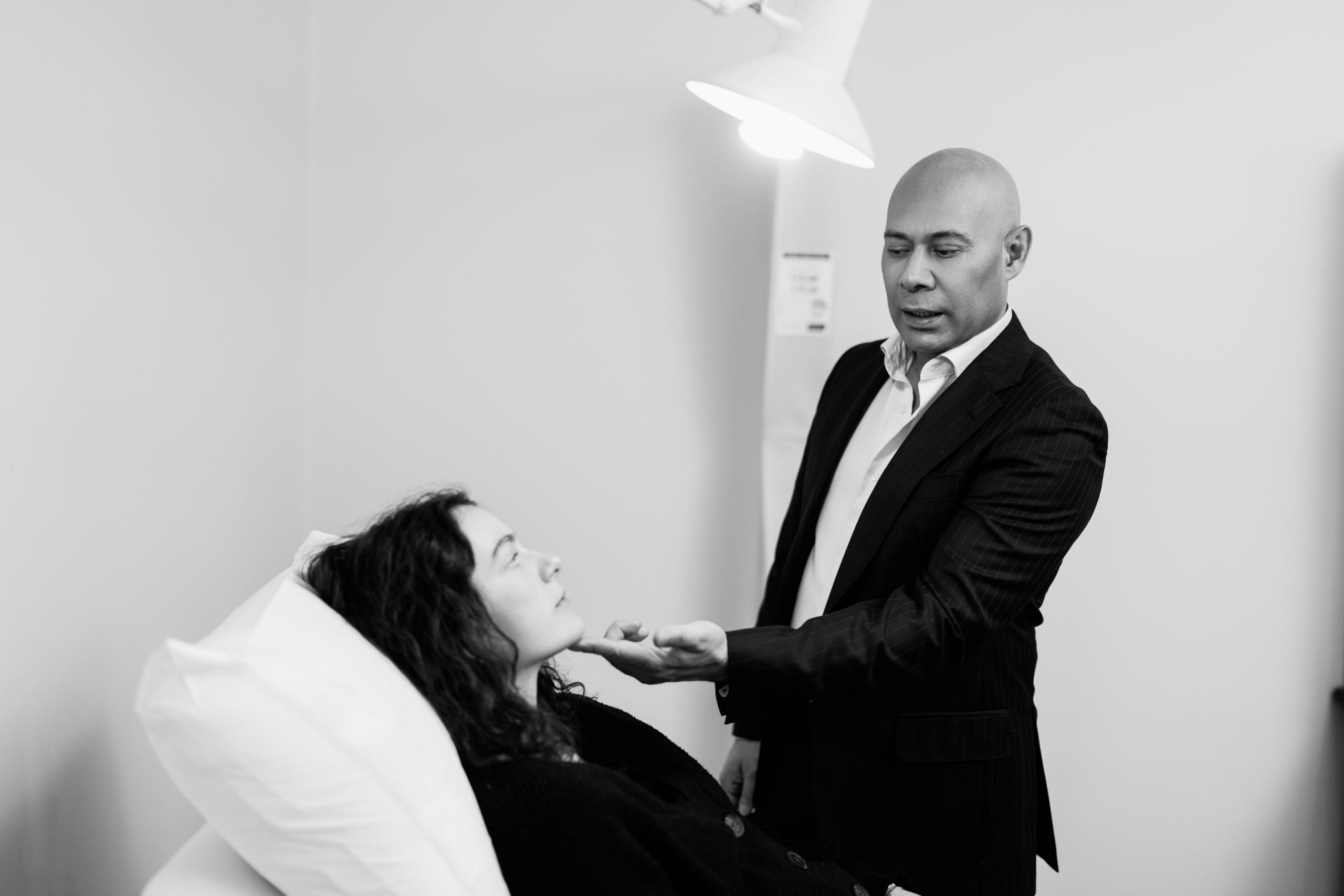
Dr. Sim Lew-Gor - Plastic Surgeon in Melbourne and Wagga Wagga Conducting a Facial Assessment
Planning Your treatment

Planning the Right Approcach at Consultation

A consultation provides a detailed assessment of the facial structure and the factors contributing to loss of jawline definition. From this, a treatment plan is developed that addresses the actual causes of change rather than its surface appearance alone. This may involve non-surgical treatment, surgical correction, or a combination of both, and the plan is specific to the individual rather than applied by default.

Not every patient who presents with jowling or jawline softening will require a facelift, and not every facelift needs to include the neck. The consultation is designed to establish what is genuinely needed and what is not.

Frequently Asked Questions

Questions most commonly raised about neck ageing and skin laxity.
What causes jowls?
Jowls typically result from descent of the deeper facial tissues combined with changes in skin elasticity and volume distribution in the lower face. The retaining ligaments that hold the facial tissues in place gradually weaken, allowing tissue to descend below the mandibular border. This process is influenced by genetics and individual facial structure as well as age, which is why the timing and pattern varies considerably between patients.
Can non-surgical treatments correct jowls?
Non-surgical treatments can provide limited improvement in patients with early or mild jowling, particularly where skin quality is the dominant issue. They do not reposition descended tissues or address significant structural change. In patients with established jowling driven by deeper tissue descent, the improvement achievable with non-surgical treatment alone is limited, and surgery is likely to produce a more complete and lasting result.
Is a facelift always required?
Not always. Suitability for surgery depends on the severity of the structural change, the extent of skin laxity, and overall facial proportions. Some patients present early enough that a more limited approach is appropriate; others will find on assessment that their pattern of change is not yet significant enough to warrant surgery. The decision is made through careful clinical assessment rather than by default.
Will treatment look unnatural?
Not when performed with restraint. The goal is to restore natural definition to the jawline rather than to create exaggerated contours or alter the character of the face. A well-planned and well-executed result should appear more balanced and composed, without any obvious sign of surgical intervention.
Can the jawline be treated without addressing the neck?
In some cases, yes. Where neck changes are minimal and the primary concern is limited to the lower face, a focused approach may be appropriate. In many patients, however, the jawline and neck are structurally connected, and treating the jaw without considering the neck can produce a result that looks imbalanced. This is assessed individually during consultation.
How long do results last?
Longevity depends on the treatment approach and individual factors including skin quality, genetics and lifestyle. Surgical correction of deeper structural descent typically provides longer-lasting improvement than surface treatments, because the change is structural rather than temporary. Ageing continues, but from a more favourable starting point.
Is ageing the only cause?
Ageing is the primary factor for most patients, but genetics and individual facial structure also contribute. Some patients develop significant jowling earlier than others because of inherited differences in ligament strength, fat distribution or skeletal support. This is why suitability for treatment is determined by the pattern of structural change rather than by age alone.
When should treatment be considered?
When the changes are noticeable to the patient, consistent over time, and confirmed on clinical assessment to reflect structural change that is appropriate to address. There is no fixed age or threshold. The right time is when the concern is meaningful to the individual and when assessment confirms that treatment will produce a genuine improvement.
Areas of Concern

You May Also Be Experiencing

Also consider
Neck Ageing & Skin Laxity
The jawline and neck age as a connected unit. Changes in the submental region frequently contribute to the softening of the lower facial border and are often best addressed together.
Also consider
Tired or Aged Appearance
A general sense of looking older or more tired often reflects changes across the face and neck rather than a concern confined to one region alone.
Also consider
Eyelid Heaviness & Under-Eye Bags
Upper and lower facial changes frequently occur together. Understanding both allows for more complete and balanced treatment planning across the whole face.
Also consider
Under Eye Hollows & Dark Circles
Volume loss in the midface can alter the balance of the lower face and contribute to the overall impression of facial ageing that patients often associate with jawline changes.
25+
Years of surgical experience, face & neck
15+
Years in aesthetic medicine
2
Locations — Melbourne & Wagga Wagga
AHPRA Registered
All treatments within Australian medical regulation & TGA standards
Dr. Sim Lew-Gor — facial Plastic Surgery Clinic in Melbourne & wagga wagga

A considered approach begins with consultation

Assessment
·
Planning
·
Suitability
Changes along the jawline often affect the entire lower face. As definition softens and heaviness develops beneath the jaw or through the jowl region, the face can begin to look older or less structured than before.

The goal of treatment is not to create an unnaturally sharp jawline, but to restore clearer definition and better support in a way that still looks natural to the individual.
Disclaimer: All treatments are subject to individual assessment and may not be suitable for all patients. Results vary between individuals and cannot be guaranteed. A consultation with Dr Sim Lew-Gor is required to determine the most appropriate treatment for your needs.
© 2025 Dr Sim Lew-Gor. All rights reserved.
AHPRA registered. All procedures performed in accordance with Australian medical standards.
Sitemap