Home
Non-Surgical Treatments
Expression & Muscle Line Assessment
Non-Surgical Treatments – Muscle & Contour

Expression & Muscle Line Assessment

Dr Sim Lew-Gor | Facial Plastic Surgery & Aesthetic Medicine
Most people describe their concern in terms of shape: a jaw that feels too square, a neck that looks banded, shoulders that look heavy, or a lower face that looks tense rather than relaxed.

In some people, the cause is not fat or bone but a strong underlying muscle shaping the contour. An assessment identifies whether muscle is the main cause, as this determines which options may help.
Begin with Consultation
Dr Sim Lew-Gor examines the muscle at rest and in movement, alongside your proportions and underlying structure, before discussing any option.
  • Wide or square jaw
  • Jaw clenching & grinding
  • Neck bands
  • Lower face tension
  • Neck & shoulder contour
Why Muscle-Related Contour Needs Careful Assessment

Dr. Sim Lew-Gor on Muscle and Contour

"Understanding the cause of the contour, whether muscle, fat or bone, matters more than the treatment itself."
Stethoscope with red tubing on a white surface
Jaw & Neck Assessment in Melbourne & Wagga Wagga

When a Muscle Shapes the Contour

Three muscles are most often involved. The masseter, the main chewing muscle along the jaw, can enlarge and widen the lower face, often in people who clench or grind. The platysma, a thin muscle running from the chest to the lower face, can form vertical neck bands and pull down along the jawline. The trapezius, which spans the back of the neck and shoulders, can dominate the transition from neck to shoulder.

If a contour is caused mainly by fat, loose skin or bone, treatment directed at muscle will have little effect, which is one of the most common reasons for disappointment.
A Shift in Thinking

From Reducing Muscle to Restoring Proportion

The guiding principle
Function comes before appearance.

Appearance-Only Thinking

Muscle was treated as a shape to reduce.
Every wide jaw assumed to be muscle
Function not considered
Treated as routine
Repeated without review
Disappointment when the cause was fat or bone

Functional Assessment

Muscle, fat and bone are distinguished first.
Cause confirmed by examination
Chewing, posture and comfort considered
Individual, careful planning
Ongoing suitability reviewed
No treatment where muscle is not the cause
Assessed Area by Area

Areas Assessed

Each muscle has a different role, and each is assessed differently.
01
Masseter and the Lower Face
An enlarged masseter can widen the lower face and may be linked to clenching or grinding. In a face that already lacks definition, though, the masseter also provides support, so reducing its influence is not suitable for everyone.
02
Platysma and the Jawline
Neck bands and downward pull along the jawline are assessed where muscle activity is a main contributor. This does not lift the neck or address loose skin.
03
Trapezius and the Neck
Where the upper trapezius is overdeveloped, its effect on neck length and shoulder contour is assessed alongside posture and any discomfort.
04
When Muscle Is Not the Cause
Fat, loose skin or bone shape need different approaches, including neck lift surgery for loose neck skin.
05
Clenching and Grinding
Where jaw function or discomfort is the main concern, see the Therapeutic Neuromuscular Consultation.
25+
Years of surgical experience, face & neck
4
International surgical fellowships
2
Locations in Melbourne & Wagga Wagga
FRACS SURGEON
FELLOW OF THE ROYAL AUSTRALASIAN COLLEGE OF SURGEONS
Jaw & Neck Assessment in Melbourne & Wagga Wagga

What to Expect Over Time

Response varies between patients. The timeframes below are a general guide only.
Days 1–2
Minor marks
Bruising, swelling or tenderness can occur and usually settles quickly.
Weeks 2–6
Gradual change
Any change in contour develops gradually over several weeks rather than immediately.
Following months
Review
Results are temporary. Whether further treatment remains appropriate is reviewed over time.
Results, Risks & Expectations

What a Muscle-Focused Plan Aims to Achieve

Where muscle is a main contributor, the aim is a more proportionate contour that develops gradually, while keeping normal function. It cannot remove fat, tighten skin, change bone or replace surgery. Results vary between individuals and cannot be guaranteed.

All treatment carries risk. Risks include bruising, swelling and tenderness, and temporary changes such as reduced chewing strength or endurance, an uneven smile, neck weakness or difficulty swallowing, and shoulder fatigue. Research is ongoing into whether repeated long-term treatment of the jaw muscle may affect jawbone density.

Risk can be reduced through careful assessment and planning, but it cannot be eliminated. Your individual risks are discussed in full at consultation.
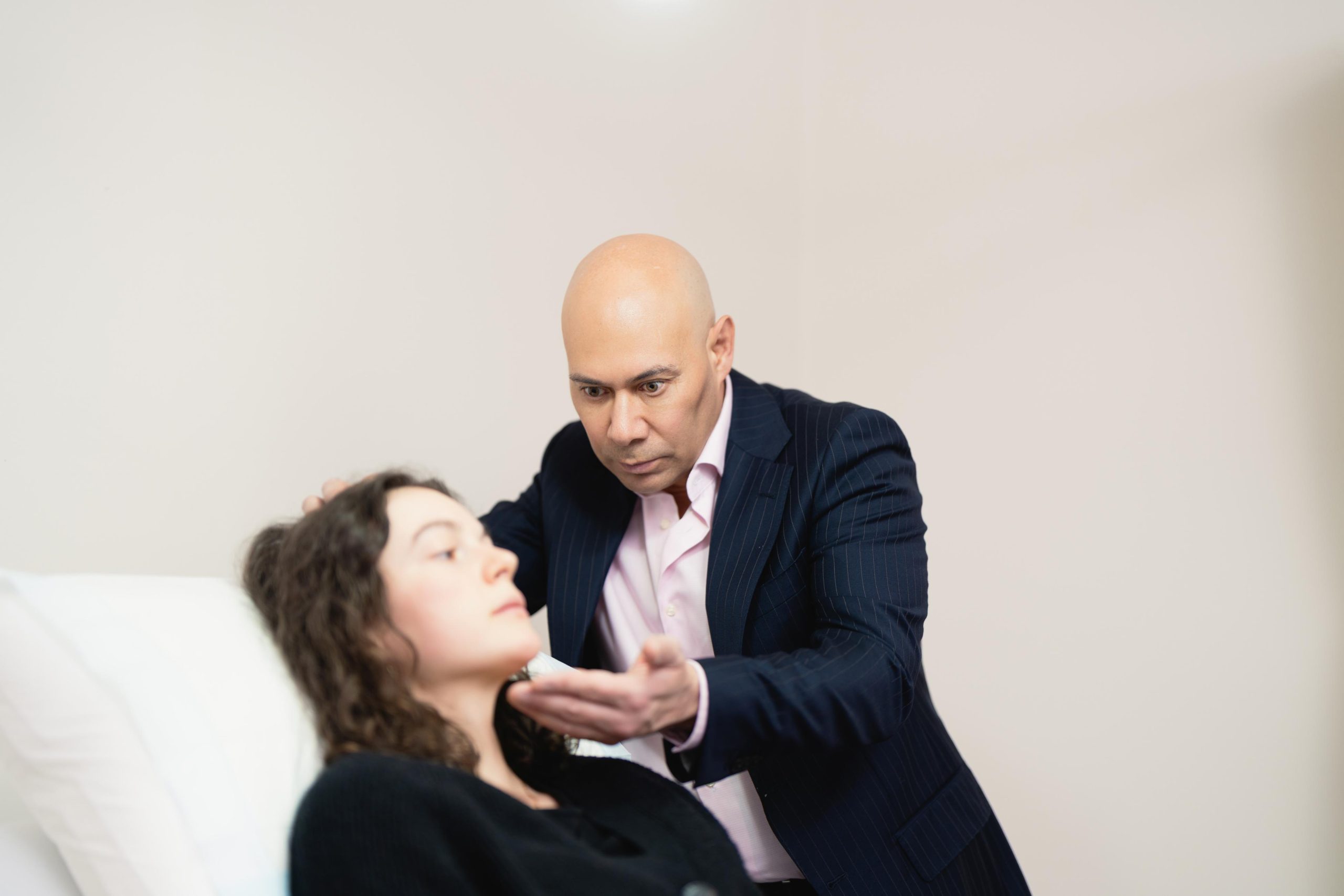
Dr Sim Lew-Gor beside a reclining person, one hand on their head and the other beneath their chin
Consultation & Treatment Planning

Deciding If Treatment Is Right at Consultation

Consultation is about understanding the face and neck well enough to decide whether treatment is appropriate at all.
Assessment considers muscle activity, proportions, underlying structure, and the interaction between movement and form.

In some people the answer is clear. In others, the right decision is to do nothing.
What Consultation Involves
Jaw
Masseter size, jaw shape and clenching or grinding
Neck
Platysma bands and jawline definition
Shoulders
Trapezius size and the neck-to-shoulder line
Other Causes
Fat, loose skin and bone structure
Expectations
An honest account of what is achievable, function and risks

Frequently Asked Questions

Questions most commonly raised about muscle-related contour.
How do I know if my jaw is wide because of muscle or bone?
A muscular jaw often feels firm when you clench and may be linked to grinding, while a bony jaw keeps its shape regardless. An examination is needed to tell the difference.
Can my chewing be affected?
Any treatment that reduces masseter activity may temporarily reduce chewing strength or endurance. This is discussed in detail beforehand.
Can repeated treatment affect the jawbone?
Some research suggests long-term reduction in muscle loading may affect jawbone density. The significance is still being studied, which is why treatment is approached thoughtfully rather than routinely.
Can neck bands be improved without surgery?
In some people, where muscle activity is a main contributor. It does not lift the neck, remove loose skin or reposition deeper tissue.
Why does shoulder contour need medical assessment?
The trapezius supports posture and shoulder stability, so function is assessed as well as appearance.
Can this replace surgery?
No. Muscle is only one part of contour. Fat, skin and structural ageing need different approaches, including surgery.
Areas of Concern

You May Also Be Experiencing

Also consider
Sagging Jawline & Jowls
The lower face and neck age as a connected unit. Jowling and loss of jawline definition frequently occur alongside neck laxity and are often best addressed together.
Also consider
Tired or Aged Appearance
A general sense of looking older or more tired often reflects changes across the face and neck rather than a concern confined to one region alone.
Also consider
Eyelid Heaviness & Under-Eye Bags
Upper and lower facial changes often occur in parallel. Understanding the full picture allows for more balanced and coherent treatment planning.
Also consider
Under Eye Hollows & Dark Circles
Volume changes in the midface and eye area can contribute to the overall impression of fatigue that patients often notice alongside neck changes.
Dr Sim Lew-Gor, Facial Plastic Surgeon in Melbourne & Wagga Wagga

All muscle-related treatment begins with consultation

Assessment
·
Function
·
Privacy
When the cause is identified correctly, change tends to be quiet, gradual and proportionate.
Start with an assessment of your jaw, neck and shoulders, and an honest conversation about your options.
Disclaimer: All treatments are subject to individual assessment and may not be suitable for all patients. Results vary between individuals and cannot be guaranteed. A consultation with Dr Sim Lew-Gor is required to determine the most appropriate treatment for your needs.