Home
Non-Surgical Treatments
Submental & Jawline Profile Assessment
Non-Surgical Treatments – Submental & Jawline

Submental & Jawline Profile Assessment

Dr Sim Lew-Gor | Facial Plastic Surgery & Aesthetic Medicine
Fullness under the chin or along the jawline is often described simply as "fat". It is not always that simple. In many people, the area is shaped by a combination of fat, skin quality, muscle, jaw structure and chin projection.

When these are not assessed properly, treatment may reduce volume without improving definition. Identifying the main cause determines which options are likely to help.
Begin with Consultation
Dr Sim Lew-Gor assesses whether fat, skin, muscle or structure is the main cause of fullness before discussing any surgical or non-surgical option.
  • Fullness under the chin
  • Loss of jawline definition
  • Skin laxity in the neck
  • Neck muscle bands
  • Chin projection
Why the Area Under the Chin Requires Precision

Dr. Sim Lew-Gor on the Submental Region

"The outcome is determined less by the treatment, and more by the accuracy of the assessment that comes before it."
Overhead surgical light and monitors in an operating theatre, with a blurred figure in the foreground
Jawline & Submental Assessment in Melbourne & Wagga Wagga

What Shapes the Area Under the Chin

Fullness under the chin can come from excess fat, from loose skin, from platysma muscle banding, or from a chin that sits further back and gives less support to the neck contour. Often, several of these are present at once.

Where localised fat is the main cause and the skin has good elasticity, non-surgical options may be discussed. Where skin laxity, muscle banding or jaw structure is the main cause, other approaches, including surgery, are more likely to help.

The area cannot be assessed in isolation from the jawline, chin and neck, because anatomically and visually they are continuous.
A Shift in Thinking

From Reducing Volume to Restoring Definition

The guiding principle
Reduction alone does not restore structure.

Volume-Only Thinking

Fullness was assumed to be fat and treated as such.
All fullness treated as fat
Skin quality not considered
Chin projection overlooked
One approach for every neck
Limited or disappointing change

Profile Assessment

Fat, skin, muscle and structure are assessed together.
The main cause identified first
Skin elasticity assessed
Chin and jawline considered
Surgical and non-surgical options compared
No treatment where none is needed
Chosen According to Assessment

Options for the Submental and Jawline Area

The right option depends on what is producing the fullness.
01
Localised Fat
Where fullness is mainly small, pinchable fat and the skin has good elasticity, non-surgical options may be discussed. These are usually staged over several sessions.
02
Larger Fat Volumes
Liposuction can remove larger volumes of fat than non-surgical options.
03
Chin Projection
Where the chin sits further back, improving projection can change how the neck and jawline are seen. See Lower Face & Chin Profile Assessment or Chin Augmentation.
04
Loose Skin and Muscle Bands
Neck lift surgery addresses skin laxity and platysma banding, which non-surgical options cannot correct.
05
Combined and Staged Plans
Some patients benefit from a combination, such as chin support with skin-quality treatment, staged over time.
25+
Years of surgical experience, face & neck
4
International surgical fellowships
2
Locations in Melbourne & Wagga Wagga
FRACS SURGEON
FELLOW OF THE ROYAL AUSTRALASIAN COLLEGE OF SURGEONS
Submental Assessment in Melbourne & Wagga Wagga

Recovery and Planning

Recovery depends on the option recommended. The timeframes below are a general guide for non-surgical options only.
Weeks 1–2
Swelling
Swelling under the chin can be marked at first and may temporarily make the area look fuller. Bruising, tenderness and numbness can also occur.
Weeks 4–8
Gradual change
As swelling settles, any change develops progressively rather than immediately.
Months 2–3
Assessment
The result is usually assessed after eight to twelve weeks, before any further session is considered.
Results, Risks & Expectations

What a Submental Assessment Aims to Achieve

The aim is a treatment plan that improves definition in a way that makes sense for the whole face, rather than reducing volume alone. Non-surgical options do not tighten significant skin laxity or reposition tissue, and weight changes can affect the area over time. Results vary between individuals and cannot be guaranteed.

All treatment carries risk. Non-surgical treatment in this area can cause marked swelling, bruising, tenderness and numbness, and, rarely, temporary weakness of lower lip movement due to nearby nerves. Surgical options carry the risks of surgery and anaesthesia, including bleeding, infection, scarring and nerve injury.

Risk can be reduced through careful assessment, mapping of the area and technique, but it cannot be eliminated. Your individual risks are discussed in full at consultation.
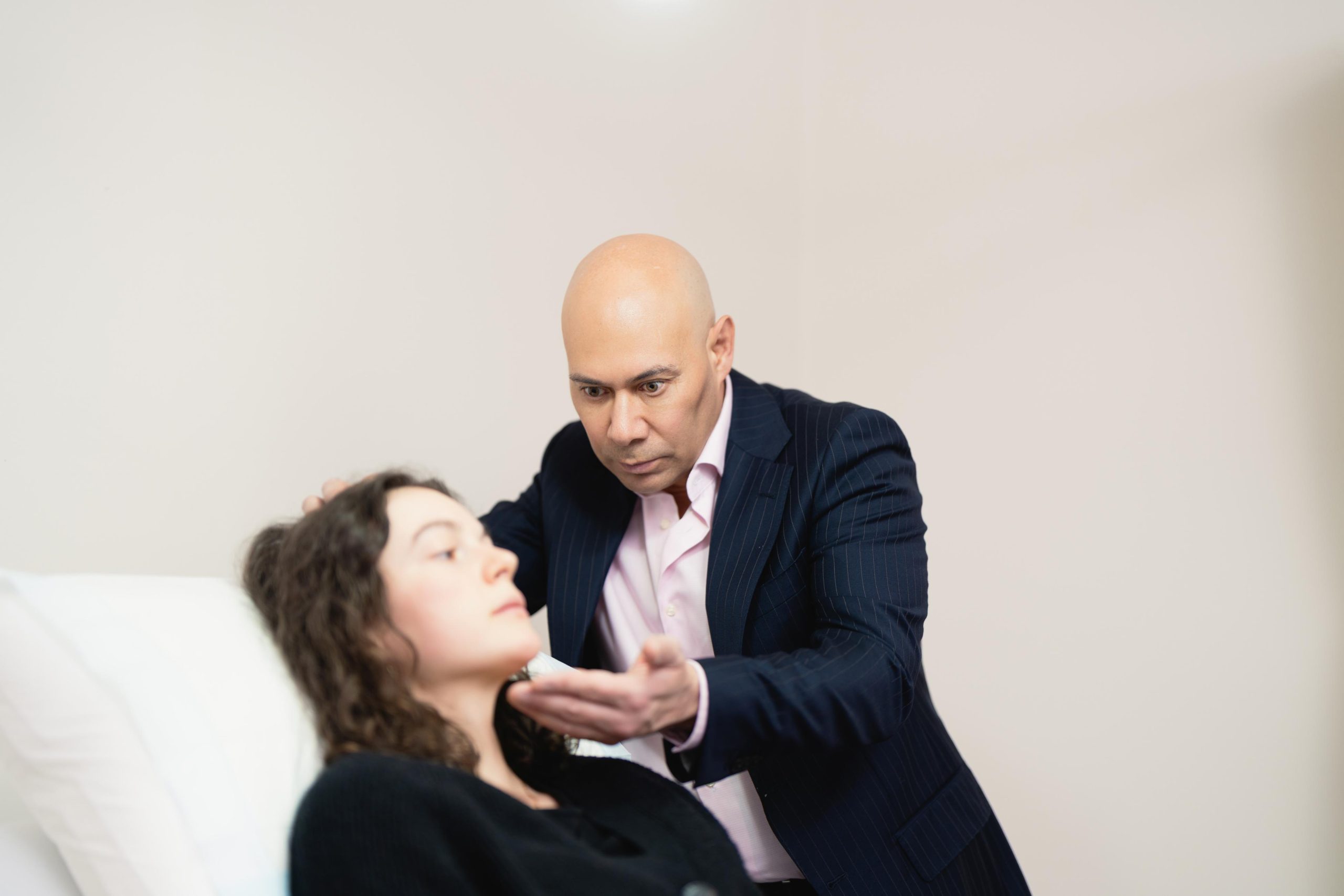
Dr Sim Lew-Gor beside a reclining person, one hand on their head and the other beneath their chin
Consultation & Treatment Planning

Deciding on the Right Approach at Consultation

The most important step is determining whether fat is truly the main factor in what you see. This needs a careful assessment of fat, skin and muscle, and of your overall facial proportions.

For some people, non-surgical treatment is appropriate. For others, a different approach will help more, and some need no treatment at all.
What Consultation Involves
Fat
Whether fullness is localised and pinchable
Skin Quality
Elasticity, laxity and likely ability to retract
Platysma
Muscle banding and tone
Chin & Jaw
Chin projection and jawline support
Expectations
An honest account of what is achievable, the timeline and risks

Frequently Asked Questions

Questions most commonly raised about fullness under the chin.
Is a double chin always caused by fat?
No. Loose skin, platysma muscle banding, a chin that sits further back and jaw structure can all contribute. Identifying the main cause is the first step.
Can fullness under the chin be treated without surgery?
In some people, where the fullness is mainly small, localised fat and skin elasticity is good. Suitability is assessed at consultation.
Why does the area sometimes look worse before it looks better?
With some non-surgical options, swelling in the first weeks can temporarily make the area look fuller. This is discussed before any treatment.
Why do some people see little change?
Usually because the fullness was mainly caused by skin, muscle or structure rather than fat, so reducing fat does not change the overall appearance.
Can non-surgical options replace liposuction or a neck lift?
No. They are only suitable for small, localised fat deposits. Liposuction removes larger volumes, and neck lift surgery addresses loose skin and muscle.
Is there a risk to the nerves?
There is a recognised risk of temporary weakness of lower lip movement if nearby nerves are affected. This risk is explained at consultation.
Areas of Concern

You May Also Be Experiencing

Also consider
Sagging Jawline & Jowls
The lower face and neck age as a connected unit. Jowling and loss of jawline definition frequently occur alongside neck laxity and are often best addressed together.
Also consider
Tired or Aged Appearance
A general sense of looking older or more tired often reflects changes across the face and neck rather than a concern confined to one region alone.
Also consider
Eyelid Heaviness & Under-Eye Bags
Upper and lower facial changes often occur in parallel. Understanding the full picture allows for more balanced and coherent treatment planning.
Also consider
Under Eye Hollows & Dark Circles
Volume changes in the midface and eye area can contribute to the overall impression of fatigue that patients often notice alongside neck changes.
Dr Sim Lew-Gor, Facial Plastic Surgeon in Melbourne & Wagga Wagga

All jawline and submental treatment begins with consultation

Assessment
·
Planning
·
Suitability
When the cause is identified correctly, the plan makes sense for the face as a whole.
Start with an assessment of your jawline and neck, and an honest conversation about your options.
Disclaimer: All treatments are subject to individual assessment and may not be suitable for all patients. Results vary between individuals and cannot be guaranteed. A consultation with Dr Sim Lew-Gor is required to determine the most appropriate treatment for your needs.