
Home
Non-Surgical Treatments
Facial Balance & Profile Harmonisation
Surgical Procedures – Facial Balance & Profile Harmonisation

Facial Balance & Profile Harmonisation

Dr Sim Lew-Gor | Facial Plastic Surgery & Aesthetic Medicine
Facial aesthetics is rarely about a single feature, even though patients understandably experience it that way.

A nose may feel too prominent, yet the true issue may be insufficient projection of the chin. A jawline may appear soft, but the deeper cause may lie in lower facial support, submental structure, or midface descent. The under-eye may appear tired not because the skin is darker, but because the lid–cheek junction has lost continuity and now absorbs light differently. What patients call a "problem area" is often only the point at which a larger imbalance becomes visible.
Assessment & Treatment
Dr Sim Lew-Gor assesses your face in front and profile view, including how it moves, before considering whether any treatment is needed.
  • profile assessment
  • chin & lower face
  • midface support
  • nose & lip relationship
  • expression & movement
why proportion matters more than any single feature

Dr. Sim Lew-Gor on Facial Balance

"Getting it right depends less on what to do, and more on whether to do anything at all."
Person tying a surgical mask behind their head beneath an overhead surgical light
Facial Balance & Profile Harmonisation in melbourne & wagga wagga

How the Eye Actually Reads Proportion

The human eye is extraordinarily sensitive to proportion, but not in the simplistic way popular references often suggest. People are not drawn to faces because those faces obey a single numerical formula. They are drawn to faces that feel coherent - where the profile is stable, the transitions between features are smooth, and no single feature demands disproportionate attention from the rest.

Classical references such as facial thirds, profile lines, and the so-called golden ratio remain useful as analytical tools, but contemporary literature is increasingly clear that these are references rather than rules. Real faces are individual, and what matters most is not mathematical purity but whether the relationships between the forehead, nose, lips, chin, jawline, and cheeks make structural sense together.
A Shift in Thinking

From Single Features to Facial Relationships

The guiding principle
A small change in the right place can matter more than a larger charnge in the obvious one. 

Feature-by-Feature

Each concern is treated where it appears.
The most obvious feature treated first
Fixed formulas and trends
Features changed in isolation
Volume added across several areas
Results that can feel incomplete

Relational assessment

Features are assessed by how they relate to each other.
The cause of imbalance identified first
Proportion used as guides, not rules
Front, profile, and movement considered
Placement and restraint over quantity
No treatment where proportions are already strong
Facial Balance & Profile Harmonisation In melbourne & wagga wagga

Why Profile Analysis Matters

When the face is viewed in profile, the hierarchy of structures becomes much easier to read. The chin may be under-projected relative to the nose. The lips may sit too far forward or too far back in relation to the maxilla and mandible. The cervicomental angle may appear blunted not because of fat alone, but because the anterior support of the chin is insufficient.

What the patient experiences as dissatisfaction with one feature is frequently a response to this relational imbalance.

This is reflected not only in clinical practice but also in public discussion. Patients who initially identified a nose problem or a wide face problem often come to realise that a chin, jawline, or lower-third proportion issue was contributing significantly to what they were seeing.
Gloved hand holding forceps selecting an instrument from a surgical tray
Chosen According to Assessment

Non-Surgical Approaches to Facial Balance

Restoring balance can involve very different approaches depending on the anatomy.
01
The Chin
The chin anchors the lower face. A modest change in chin projection can affect how the nose, lips, jawline and neck are read together. Over-projecting or widening a chin that does not need it can make the lower face look heavy.
02
The Midface
Support in the cheek affects how the lower eyelid, nasolabial fold and jawline are seen. Where support is the issue, addressing the midface may change the impression of the whole face.
03
Movement
Where muscle patterns drive the imbalance, movement rather than shape may be the key factor, and this is assessed separately.
04
Surgical Options
Rhinoplasty, chin augmentation or facelift may be more appropriate where the change needed is structural.
05
Skin Quality
Treatments aimed at collagen and skin quality may support the overall result without changing shape.
25+
Years of surgical experience, face & neck
4
International surgical fellowships
2
Locations in Melbourne & Wagga Wagga
FRACS SURGEON
FELLOW OF THE ROYAL AUSTRALASIAN COLLEGE OF SURGEONS
facial balancing in Melbourne & Wagga Wagga

Recovery and Planning

Recovery depends on the approach recommended. The timeframes below are a general guide for non-surgical treatment only.
Days 1–3
Swelling and bruising
Mild swelling, bruising or tenderness may occur and usually settles within a few days.
Weeks 1–2
Settling
Once swelling settles, proportions can be assessed more accurately.
Following months
Review
Further change, if any, is planned only after the face has been reviewed as a whole.
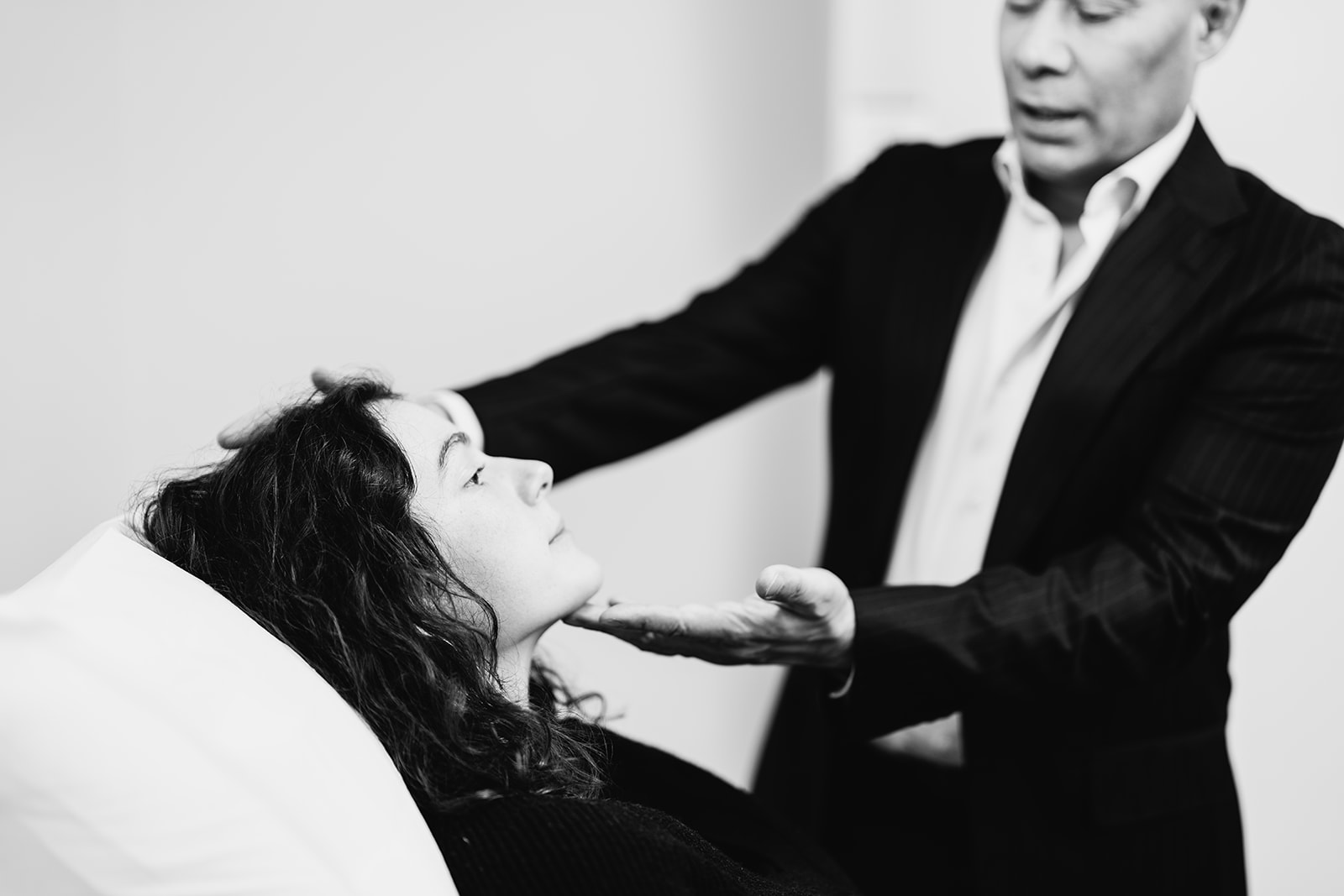
Dr Sim Lew-Gor speaking beside a reclining person, one hand on their head and the other beneath their chin
Facial Balance & Profile Harmonisation in melbourne & wagga wagga

Results, risks, & expectations

The aim is not to redesign the face or follow a trend, but to reduce visual imbalance so features stop competing with each other, while you still look like yourself. Results vary between individuals and cannot be guaranteed.

All treatment carries risk. Non-surgical treatment can cause swelling, bruising, asymmetry, lumps, infection and, rarely, blocked blood flow causing skin damage or vision loss. Surgical options carry the risks of surgery and anaesthesia.

Risk can be reduced through careful assessment, planning and technique, but it cannot be eliminated. Your individual risks are discussed in full at consultation.
Facial Balance & Profile Harmonisation In melbourne & wagga wagga

How the Midface Influences the Whole Face

The midface is equally influential, though often less intuitively understood.

Support in the cheek and lateral midface affects not only the contour of the face itself, but the way the lower eyelid, nasolabial fold, and jawline are perceived. As support is lost or redistributed, the face begins to cast different shadows.

Hollows deepen, folds appear more pronounced, and the lower face may seem heavier simply because the upper and middle thirds no longer provide the same structural counterbalance.

The visible sign is often secondary. The structural cause sits elsewhere.
Dr Sim Lew-Gor in a mask and loupes with a lit headlight, in front of operating theatre monitors
Person tying a surgical mask behind their head beneath an overhead surgical light
Facial Balance & Profile Harmonisation in melbourne & wagga wagga

The Role of Movement in Facial Proportion

Movement further complicates proportion in ways that static measurements cannot fully capture.

A face that is balanced at rest can still appear tense, fatigued, or severe if habitual muscular patterns are dominating expression. The forehead may overcompensate for brow heaviness. The glabella may pull inward and downward with disproportionate strength. Platysmal activity may contribute to a downward pull in the lower face and neck.

These are not separate from facial balance but are part of it. A balanced face is not merely one in which the measurements make sense. It is one in which structure and expression remain in agreement.
Facial Balance & Profile Harmonisation in melbourne & wagga wagga

Choosing the Right Tool for the Right Problem

Restoring balance may involve very different approaches depending on the anatomy.
In one patient, a modest increase in chin projection may transform the profile. In another, the issue is midface support, and the lower face only appears weak because the upper structures are no longer carrying light or volume appropriately. In another still, movement rather than shape may be the key variable, and neuromodulation may improve the expression of imbalance without altering structure at all.
Modern facial balancing can involve:
Surgery, including rhinoplasty, chin augmentation, or facelift
Filler for structural support or volumetric restoration
Neuromodulators to address dynamic imbalance
Biostimulatory treatment to improve tissue quality
Or no intervention at all, where the anatomy does not support it
What defines the approach is not the tool, but the accuracy of the diagnosis.
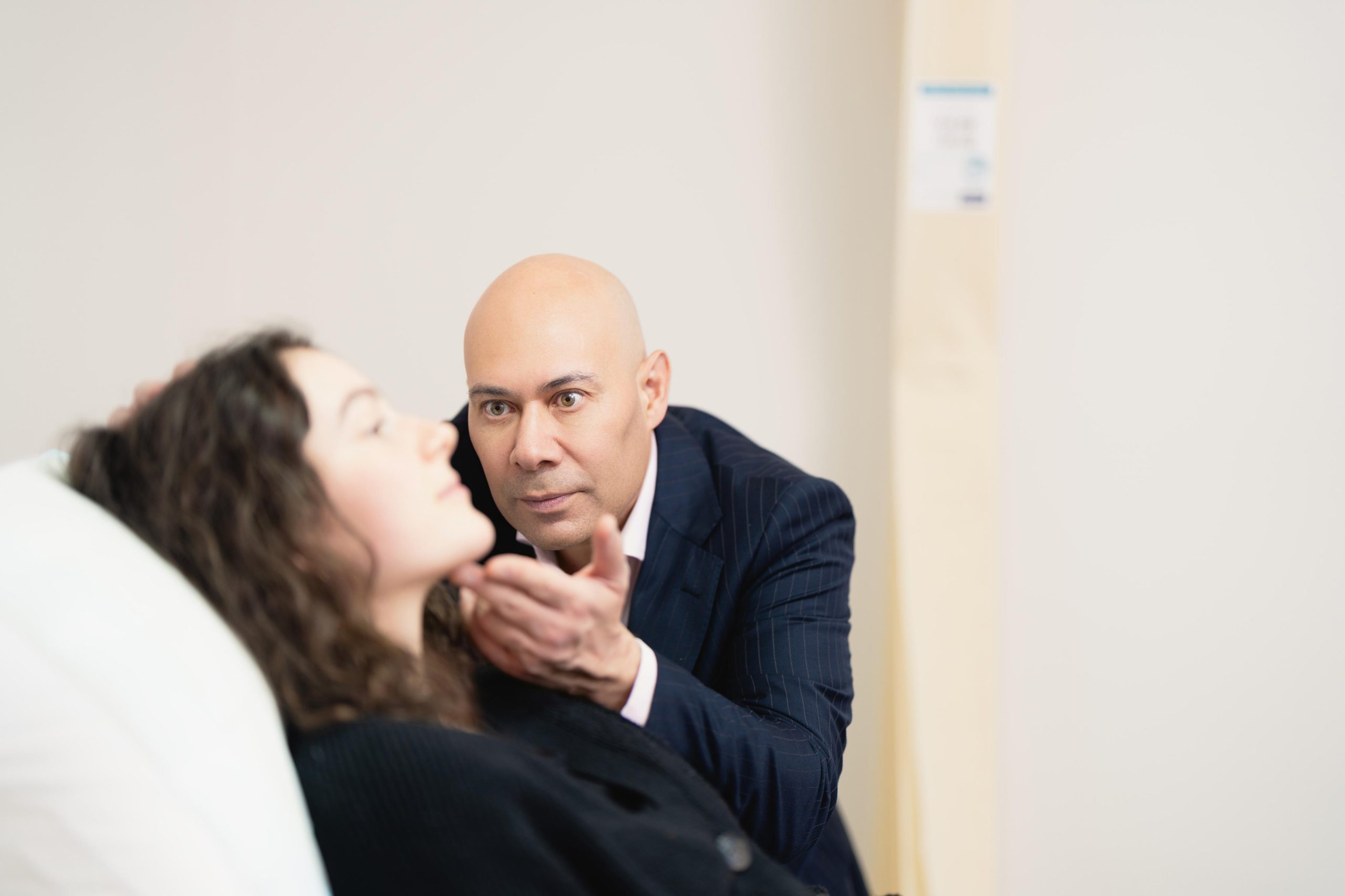
Dr Sim Lew-Gor beside a reclining person, one hand beneath their chin
Facial Balance & Profile Harmonisation In melbourne & wagga wagga

Why Treating Features in Isolation Often Disappoints

A beautifully refined nose may still feel prominent if the chin remains under-projected. Smoother skin may still leave a face looking tired if the lid–cheek junction remains hollow and the midface unsupported. Cheeks may be volumised, yet the result feels strangely incomplete if the jawline or chin has not been considered.

The face does not experience intervention feature by feature. It absorbs it relationally. Facial balance is not about doing more. It is about understanding where the imbalance begins, and then deciding whether a small, precise change in the right place may do far more than a larger change in the obvious one.
Consultation & Treatment Planning

What the Consultation Involves

Consultation cannot begin and end with your first request. It involves profile and front-view assessment, facial thirds and transitions, observation of movement, and a willingness to question first impressions where the anatomy suggests a different cause.

Where treatment is indicated, the plan is designed around your own proportions. Where it is not, that is explained clearly.
What consultation involves
Profile
Relationship between forehead, nose, chin, and neck
Front View
Facial thirds, width, and symmetry
Chin & Midface
Chin projection and cheek support
Movement 
Muscle patterns that affect expressions
Expectations
An honest account of what is achievable, the options, and risks

Frequently Asked Questions

Questions most commonly raised about neck ageing and skin laxity.
What does facial balancing actually mean?
Facial balancing is not a single treatment and it is not a synonym for adding filler everywhere. It is an approach to assessment and treatment that asks how the features of the face relate to one another, rather than treating the most obvious concern in isolation. In practice, this may involve recognising that a prominent nose is being made to look more prominent by an under-projected chin, or that a weak jawline is partly a support issue rather than only a contour issue.
Is facial balance based on the golden ratio, or is that overhyped?
The golden ratio and other proportional frameworks remain useful as analytical references, but they are not a blueprint for beauty. Contemporary research continues to show that harmony and individual consistency matter more than rigid mathematical conformity. A face can be highly attractive while deviating from classical formulas if the relationships between its features remain balanced and expressive. In clinical practice, proportions are used as guides rather than rules.
Why do so many people end up being told their chin is the issue, not their nose?
Because the chin is one of the most powerful but least intuitively recognised structures in the face. A weak or retrusive chin alters the profile, reduces lower-face support, and can make the nose look more dominant than it actually is. That does not mean every nose concern is really a chin concern. It means the face must be read relationally, not feature by feature.
Can one small treatment really improve the whole face?
Yes, sometimes significantly, if that treatment addresses a true structural pivot point. The chin is a good example. Small changes in projection can alter how the nose, lips, jawline, and neck are all perceived together. Similarly, restoring midface support may soften the entire impression of fatigue by changing light, contour, and lower-face relationships at once. The key is not the scale of the treatment, but that the right structural intervention often has consequences well beyond the area treated.
Is facial balancing the same as getting a lot of filler?
No, and this is one of the most important distinctions to make. Overfilling is increasingly recognised as something that disrupts harmony rather than restores it, particularly when volume is added without regard for how one region affects another. Facial balancing, done properly, is less about quantity and more about placement, proportion, and restraint. In many patients, the best result comes from modest changes in the right place, not large amounts of product across multiple regions.
How do you identify which feature is actually causing the imbalance?
Usually it is not obvious from a single concern or a single photograph. It requires frontal and profile assessment, observation of movement, and an understanding of which relationships in the face are primary and which are secondary. A fold may be secondary to volume loss elsewhere. A jawline may look soft because the chin lacks support. A feature may seem too large only because its proportional counterbalance is too small. Facial balancing is fundamentally an interpretative process, not a menu of fixes.
Will facial balancing make me look unlike myself?
If it does, then the treatment has probably been poorly judged. The objective is not to change identity, but to reduce disproportion and visual distraction so that the features work together more naturally. The best outcomes look like the patient, even when the profile or facial thirds have clearly improved. A good balancing result tends to look less like work and more like the face finally settling into alignment.
Does facial balance still matter with age, or is it mainly relevant for younger patients?
It matters at all ages, but the reasons change. In younger patients, balancing is often about inherited proportion, profile relationships, and structural refinement. In older patients, it increasingly involves the restoration of lost support and the way ageing has changed how features relate to one another. In both cases, the principle is the same: the face works best when it is understood as a system rather than a list of separate concerns.
Areas of Concern

You May Also Be Experiencing

Also consider
Sagging Jawline & Jowls
The lower face and neck age as a connected unit. Jowling and loss of jawline definition frequently occur alongside neck laxity and are often best addressed together.
Also consider
Tired or Aged Appearance
A general sense of looking older or more tired often reflects changes across the face and neck rather than a concern confined to one region alone.
Also consider
Eyelid Heaviness & Under-Eye Bags
Upper and lower facial changes often occur in parallel. Understanding the full picture allows for more balanced and coherent treatment planning.
Also consider
Under Eye Hollows & Dark Circles
Volume changes in the midface and eye area can contribute to the overall impression of fatigue that patients often notice alongside neck changes.
Dr. Sim Lew-Gor — facial Plastic Surgery Clinic in Melbourne & wagga wagga

A considered approach begins with consultation

Assessment
·
Planning
·
Suitability
When facial balance is restored, the result rarely looks dramatic. In fact, the better the result, the more quietly it tends to operate. The face appears more proportionate, more structured, less distracted by competing signals. The person still looks like themselves, but the face no longer asks to be interpreted feature by feature. It simply reads as one coherent whole.

Book your consultation with Dr. Sim Lew-Gor below.
Disclaimer: All treatments are subject to individual assessment and may not be suitable for all patients. Results vary between individuals and cannot be guaranteed. A consultation with Dr Sim Lew-Gor is required to determine the most appropriate treatment for your needs.