
Home
Non-Surgical Treatments
Lower Face & Chin Profile Assessment
Non-Surgical Treatments – Chin & Lower Face

Lower Face & Chin Profile Assessment

Dr Sim Lew-Gor | Facial Plastic Surgery & Aesthetic Medicine
The chin is rarely the feature people notice first. Most people arrive focused on the nose, lips or jawline, when the chin often determines how all three are read together.

A chin that is under-projected, short or asymmetrical changes the profile, can make the nose look more prominent and the area under the chin look fuller. For some people, non-surgical treatment can refine projection and contour within the limits of their existing anatomy.
Begin with Consultation
Dr Sim Lew-Gor assesses what is producing the imbalance in your lower face, and whether non-surgical treatment, surgery or no treatment is most appropriate.
  • Under-projected or recessed chin
  • Chin asymmetry
  • Chin-to-jawline transition
  • Fullness under the chin
  • Profile balance with the nose
Why the Chin Shapes the Whole Profile

Dr. Sim Lew-Gor on the Chin

"A well-treated chin rarely draws attention to itself. It lets the nose, lips and jawline read clearly together."
Dr Sim Lew-Gor reviewing a document with a medical colleague
Chin Profile Assessment in Melbourne & Wagga Wagga

How the Chin Shapes the Lower Face

The chin anchors the lower third of the face, influences the angle between the neck and jaw, and acts as the endpoint of the profile. When it sits further back, the jawline often looks weaker, the neck fuller, and the nose more prominent even when it is in proportion.

People often ask about a stronger chin when the real concern is the area beneath it. A chin that lacks projection gives less support to the neck contour, so improving projection alone can sometimes clean up the lower profile. In others, there is genuine fat, skin laxity or heaviness under the chin, and the chin is only part of the picture.
A Shift in Thinking

From a Stronger Chin to a Balanced Profile

The guiding principle
Restore the chin's role in the face, rather than make it a statement on its own.

Feature-Led Thinking

The chin was treated as a feature to enlarge.
Projection increased as the goal
Chin assessed on its own
Same approach for every face
Risk of a heavy lower face
Surgery rarely compared

Profile-Led Thinking

The chin is assessed as part of the whole profile.
Proportion as the goal
Nose, lips, jaw and neck considered together
Conservative first treatment
Change consistent with your bone structure
Surgery recommended where more appropriate
Chosen According to Assessment

Approaches to the Chin and Lower Face

Where non-surgical treatment is appropriate, the aim depends on what the assessment shows.
01
Projection
For mild to moderate under-projection, improving forward projection so the chin reads more clearly in profile.
02
Length and Shape
In selected cases, modestly increasing chin length or refining its shape.
03
Symmetry
Refining minor differences in chin shape from side to side.
04
Jawline Transition
Smoothing the transition between the chin and jawline, so the lower face meets the neck more clearly.
05
Surgical Chin Augmentation
Where the chin sits significantly further back, or a permanent change is wanted, surgery with an implant or by repositioning the bone (sliding genioplasty) may be more appropriate.
06
Under the Chin
Where fat, skin laxity or neck ageing is the main issue, see the Submental & Jawline Profile Assessment.
25+
Years of surgical experience, face & neck
4
International surgical fellowships
2
Locations in Melbourne & Wagga Wagga
FRACS SURGEON
FELLOW OF THE ROYAL AUSTRALASIAN COLLEGE OF SURGEONS
Chin Profile Assessment in Melbourne & Wagga Wagga

Recovery and Settling

Recovery varies between patients. The timeframes below are a general guide only.
Days 1–3
Swelling and firmness
Mild to moderate swelling and bruising are common, and the chin may feel firm or unfamiliar at first.
Weeks 1–2
Settling
Early swelling can make the result look slightly overdone. The final contour is easier to judge once it settles.
Following months
Longevity
Because the chin moves little, results often last longer than in more mobile areas, which is why a conservative first treatment is preferred.
Results, Risks & Expectations

What Chin Profile Treatment Aims to Achieve

For mild to moderate under-projection, the aim is a profile that reads more clearly, with the chin, nose, lips and jawline in better proportion. Non-surgical treatment cannot replace surgery where the deficiency is significant. Results vary between individuals and cannot be guaranteed.

All treatment carries risk. Effects include swelling, bruising, tenderness and firmness. Other risks include asymmetry, lumps or an overcorrected shape, movement of the product away from where it was placed, and infection. Rarely, blocked blood flow can cause tissue damage and, if not treated promptly, permanent injury.

Risk can be reduced through careful assessment, conservative treatment and precise placement, but it cannot be eliminated. Your individual risks are discussed in full at consultation.
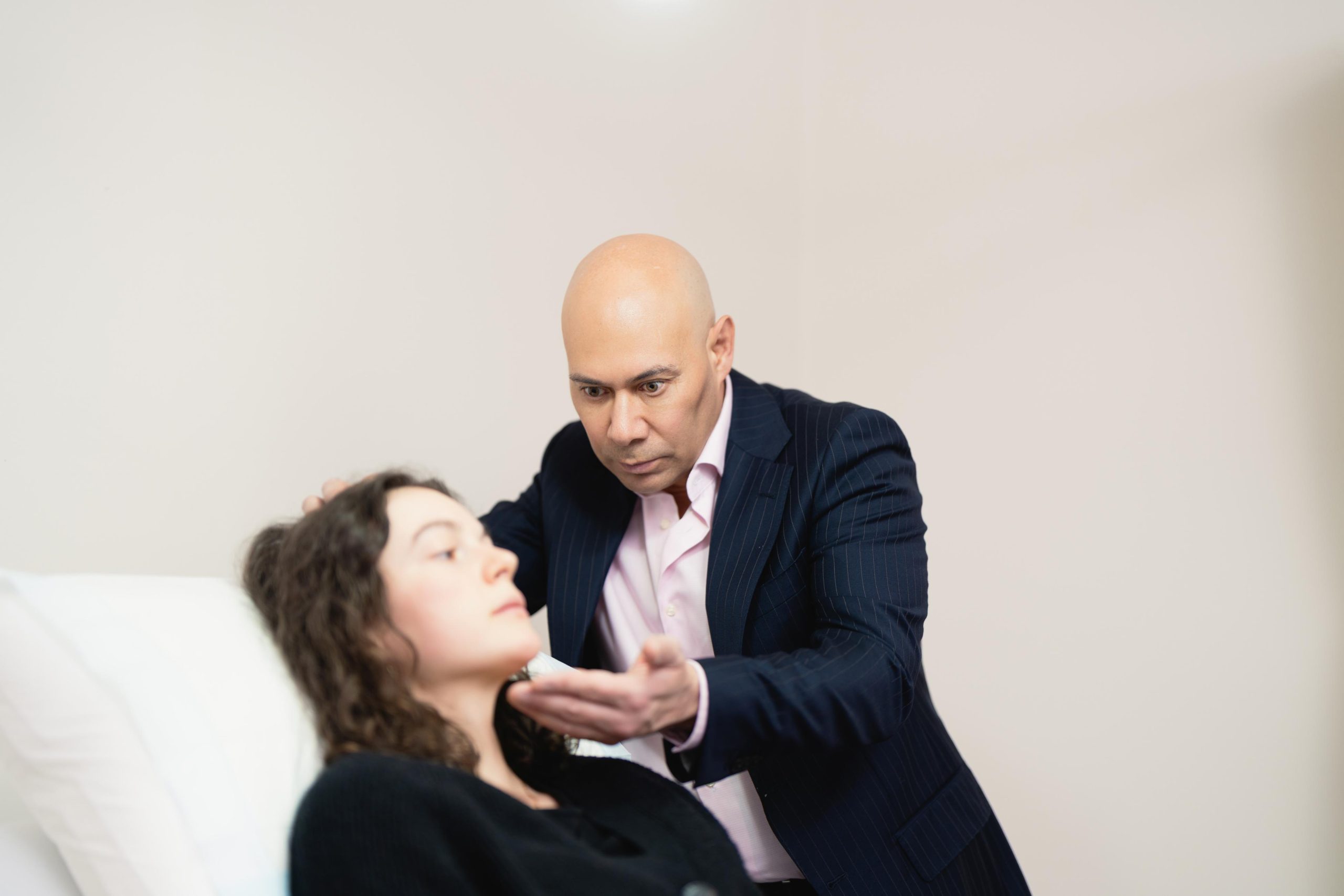
Dr Sim Lew-Gor beside a reclining person, one hand on their head and the other beneath their chin
Consultation & Treatment Planning

Deciding If Chin Treatment Is Right at Consultation

Consultation begins with a structural assessment, to understand whether the imbalance comes from chin projection, the jawline, fullness under the chin, or a combination. Many concerns turn out to be a secondary effect of a different issue.

The outcome may be a non-surgical plan, a recommendation for surgical assessment, or the advice that no treatment is needed at this time.
What Consultation Involves
Projection
Degree of chin under-projection and chin length
Symmetry
Differences in chin shape from side to side
Jawline
How the chin meets the jaw and neck
Under the Chin
Fat, skin or muscle contributing to fullness
Expectations
An honest account of what is achievable, longevity and risks

Frequently Asked Questions

Questions most commonly raised about the chin and lower face profile.
Can non-surgical chin treatment improve the profile?
For mild to moderate under-projection, a modest change can affect how the nose, lips, jawline and neck are seen together. The degree of change depends on your starting anatomy.
Will it make my jawline sharper?
It can improve how the jawline is perceived by strengthening the front of the lower face. It will not address issues further back along the jaw, fullness under the chin or loose neck skin.
Is the chin a safe area to treat?
It is generally considered more forgiving than areas such as the under-eye, but it still has important blood vessels, and serious complications, while uncommon, can occur.
Can the result move over time?
The chin's low movement tends to favour stability, but product can move or settle in unexpected ways. Conservative treatment and correct depth help reduce this risk.
Can it help with a double chin?
Sometimes indirectly, where a chin that sits further back is making the area under it look fuller. It does not treat fat or loose skin.
When is surgery better?
When the chin sits significantly further back, when a permanent change is wanted, or when non-surgical treatment would leave the profile only partly corrected.
Areas of Concern

You May Also Be Experiencing

Also consider
Sagging Jawline & Jowls
The lower face and neck age as a connected unit. Jowling and loss of jawline definition frequently occur alongside neck laxity and are often best addressed together.
Also consider
Tired or Aged Appearance
A general sense of looking older or more tired often reflects changes across the face and neck rather than a concern confined to one region alone.
Also consider
Eyelid Heaviness & Under-Eye Bags
Upper and lower facial changes often occur in parallel. Understanding the full picture allows for more balanced and coherent treatment planning.
Also consider
Under Eye Hollows & Dark Circles
Volume changes in the midface and eye area can contribute to the overall impression of fatigue that patients often notice alongside neck changes.
Dr Sim Lew-Gor, Facial Plastic Surgeon in Melbourne & Wagga Wagga

All chin treatment begins with consultation

Assessment
·
Proportion
·
Suitability
When the chin is in proportion, no single feature needs to compensate for what another lacks.
Start with an assessment of your profile and an honest conversation about your options.
Disclaimer: All treatments are subject to individual assessment and may not be suitable for all patients. Results vary between individuals and cannot be guaranteed. A consultation with Dr Sim Lew-Gor is required to determine the most appropriate treatment for your needs.